Viewers make a journey of discovery with fraternal twins Jeanne and Simon as they travel to their mother's homeland to find a brother and father they never knew in Incendies.
Incendies has received many awards and was nominated for an Academy Award, Best Foreign Language Film, but lost to In a Better World, which is also an excellent film.
Showing posts with label film. Show all posts
Showing posts with label film. Show all posts
Monday, October 31, 2011


Sunday, October 30, 2011
Scary movies for Halloween
 Tomorrow is Halloween, and The Washington Post has a slideshow of stills from nineteen "scary" movies. This photo is a still from The Texas Chainsaw Massacre of 1974. I've seen the 2003 remake, which was very good, and I have the original on my wishlist. The original is relatively expensive, so it may be excellent.
The other stills at the slideshow are from: Nosferatu, The Phantom of the Opera, Psycho, The Birds, Rosemary's Baby, Night of the Living Dead, The Exorcist, Jaws, The Omen, Carrie, Halloween, Alien, The Amityville Horror, Friday the 13th, The Shining, Scanners, An American Werewolf in London, Poltergeist, and The Thing.
The Washington Post's article is "From ‘Paranormal Activity’ to ‘Nosferatu,’ a look at the scariest movies of all time." Interestingly, a still from Paranormal Activity isn't included in the slideshow, but there is a link to "‘Paranormal Activity 3’: Is the found footage horror movie played out?"
The Los Angeles Times has "50 Creature Features," "Celluloid mutants, werewolves and blobs -- the stuff of nightmares. Play the videos, and vote for the greatest monster movie ever."
I like the Childs Play movies, which didn't make either list. "Chuckie" is scary.
I'll watch 1994's Ed Wood, which received an Academy Award for Martin Landau's makeup. Landau played Bela Lugosi.
Wednesday, October 26, 2011
Wouldn’t It Be Cool if Shakespeare Wasn’t Shakespeare?
Writing in The New York Times, Stephen Marche writes:
“Was Shakespeare a fraud?” That’s the question the promotional machinery for Roland Emmerich’s new film, “Anonymous,” wants to usher out of the tiny enclosure of fringe academic conferences into the wider pastures of a Hollywood audience. Shakespeare is finally getting the Oliver Stone/“Da Vinci Code” treatment, with a lurid conspiratorial melodrama involving incest in royal bedchambers, a vapidly simplistic version of court intrigue, nifty costumes and historically inaccurate nonsense. First they came for the Kennedy scholars, and I did not speak out, because I was not a Kennedy scholar. Then they came for Opus Dei, and I did not speak out, because I was not a Catholic scholar. Now they have come for me.You can read much more of the article at the Times by clicking this post's title.Professors of Shakespeare — and I was one once upon a time — are blissfully unaware of the impending disaster that this film means for their professional lives. Thanks to “Anonymous,” undergraduates will be confidently asserting that Shakespeare wasn’t Shakespeare for the next 10 years at least, and profs will have to waste countless hours explaining the obvious. “Anonymous” subscribes to the Oxfordian theory of authorship, the contention that Edward de Vere, the 17th earl of Oxford, wrote Shakespeare’s plays. Among Shakespeare scholars, the idea has roughly the same currency as the faked moon landing does among astronauts.
The good news is that “Anonymous” makes an extraordinarily poor case for the Oxfordian theory. ...
Friday, May 20, 2011
Apocalypse Tomorrow!
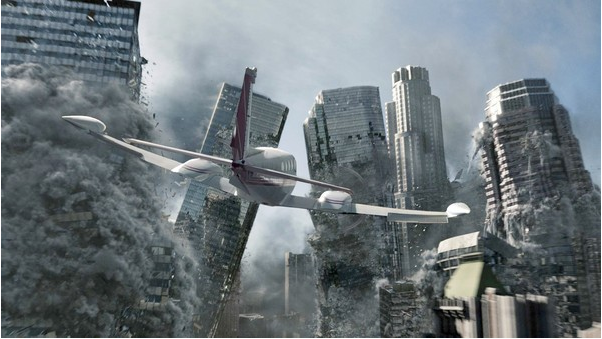 The Los Angeles Times has a short, interesting article, "Apocalypse when?: May 21 and other doomsday dates on film," about the end of the world as we know it. The article has a slideshow of stills from apocalyptic films and each is accompanied by some essential, don't-make-any-plans-without-it, be-prepared information: When; Who called it; What's going to get us; and What can save us.
This post's photo is the third in the slideshow and is a Columbia/TriStar publicity photo for 2012.
Calling 2012 for the end seems at odds with what the article states is a prediction for tomorrow: "According to Christian radio broadcaster Harold Camping of the Family Radio organization, Saturday is the first day of the "end of days," leading to the final, absolute, this-is-really-it, end-of-the-world doomsday on Oct. 21, 2011. Keep both dates free."
Of course, Harold Camping isn't a filmmaker. But, too, some filmmaker's have been mistaken about the date. The UK Guardian's "The Rapture: judgment day imminent … if US engineer has calculated right" has an interesting story about Camping's prediction.
Wednesday, February 9, 2011
In a Dark Corner
 Suppose you discover you've a rival for your spouse's affection. Wouldn't it be nice if your rival disappeared? But murder can be untidy. You could solicit someone to kill your rival. But people get caught and squeal. What if you could goad someone into killing your rival? Someone with no connection to you. You'd have the plot that drives The Dark Corner, a noir film of 1946.
The film stars Lucille Ball, Clifton Webb, William Bendix and Mark Stevens. Stevens plays "Bradford Galt," an ex-con turned private detective; Ball plays "Kathleen," Galt's receptionist/secretary and the woman behind the successful detective. You see, Galt goes into a funk when he discovers he's being followed, when someone tries to run him over with a car, and when someone frames him for murder; Kathleen picks him up each time. Clifton Webb plays "Hardy Cathcart," a wealthy gallery owner and the husband to "Mari Cathcart," played by Cathy Downs. Mari Cathcart is carrying on an affair with "Anthony Jardine," played by Kurt Kreuger. Hardy Cathcart wants Jardine to disappear, and he engages the "guy in a white suit," played by William Bendix, to goad Galt into killing Jardine. Galt and Jardine were private eye partners before Galt went to prison.
For those weaned on re-runs of Lucille Ball's "I Love Lucy" and William Bendix' "The Life of Riley" TV shows of the 1950s, it can be a surprise to see Ball and Bendix in these roles. Ball carried off an important, serious role without a single pratfall; Bendix played an effective thug, instead of an amusing, bumbling TV-dad. Instead of comedy, they did a melodrama; before some melodramas became known as film noir.
Something that distinguishes a noir film is its visual style: its lighting, and its composition of scenes and individual frames. It isn't difficult to find interesting stills in these films. The Dark Corner exemplifies and illustrates noir's visual style beautifully. The film can be seen on DVD, which includes a viewing with voiceover commentary by film historian Alain Silver and author James Ursini. They talk about the film's lighting, characters and plot, and, while doing so, they compare and contrast The Dark Corner with other noir films. Silver and Ursini collaborated to write several books, including The Film Noir Encyclopedia
Judson Hirsh's The Dark Side of the Screen: Film Noir is considered by some to be the go-to intro to film noir.
I must have enjoyed the film; it held by attention, and it was interesting to see Lucille Ball in a serious role. My copy of the DVD was obtained from a library, and I saw it (upscaled) via a blu-ray player (Sony S570) to a 1080p hi-def TV. The film's aspect ratio is 1.33:1, so it is letter-boxed, left and right. I didn't notice any scratches or dust, so some work went into the transfer from film to digital. There is little, if any, grain visible, which might lead one to suspect that considerable noise reduction was applied during the transfer, especially considering the film may have been shot on Tri-X film; without seeing the original, projected film, it's difficult to know for sure.
Sunday, January 16, 2011
Superheroes in Comic Books and Film
 Some comic books -- graphic novels, if you prefer -- are thought by some (parental units) to be violent. But the "violence" of comic books is stylized violence, which some (vermin intellectuals, a.k.a. elites) call "aestheticized violence." Stylized violence is the heart and soul of Superhero comics. Superheroes survive villians' knockout, fatal blows and use their supernatural powers to defeat their adversaries. The books' theme is classic Good vs. Evil, at times drawn in graphic black and white.
Frank Miller's Sin City appeared about twenty years ago and was adapted to film in 2005. Many, if not all, of the characters are criminals and may not be, strictly speaking, superheroes, but they are able to survive incredible violence and come back for another beating, bullet or blade. There are "good" criminals; when everyone is a criminal, aren't there bound to be "good" and "bad" criminals? It's a black and white film, with a little color used to draw attention to a character in each of its many episodes: red in The Customer Is Always Right, blonde in The Hard Goodbye, ... . Excellent!
In the mid-eighties, Watchmen was written by Alan Moore, drawn by Dave Gibbons and colored by John Higgins. A film adaptation of Watchmen appeared in 2009. The film portrays Superheroes in several lights: flawed good-guys, vigilantes and has-beens. The film is set in the mid-eighties, when Nixon -- believe it or not! -- is in his fifth term. The Blu-ray set contains some extra clips with an interview in which the comparison of Superheroes with vigilantes is made explicit. Until seeing that particular interview, I had forgotten that the mid-eighties were a time when the "Subway Shooter" and "Guardian Angels" flourished. Another extra clip attempts to discourage kids from becoming a Superhero or pretending to be one.
But one teenage boy does decide to play Superhero. Mark Millar and John Romita created Kick-Ass in 2008, and it was adapted to film last year. The film's stars are "Big Daddy" (Nicolas Cage) and "Hit-Girl" (Chloe Moretz). Hit-Girl is a young femme fatale (she's eleven), and the film was criticized for her profanity and violence, but it is stylized violence (could anyone do and survive what she did?), so I have to give her (and the film) a "You go, girl!" rating. "Kick-Ass" (Aaron Johnson) is the boy who pretends to be a Superhero.
Kill Bill, written and directed by Quentin Tarantino of Pulp Fiction fame, didn't originate in comics, but is a wonderful revenge story in which "The Bride" (Uma Thurman) avenges a wedding massacre as she searches for "Bill" (David Carradine). One rather lengthy display of The Bride's martial arts prowess and sword-fighting skill culminates in a beautiful scene (the sword fight with "O-Ren Ishi" (Lucy Liu)) that looks as though it could have been filmed in a snow globe. In another scene, The Bride's family values become apparent as she and "Vernita Green" (Vivaca Fox) engage in a knife fight. And, in yet another scene, you can witness an assassin's compassion: Sent to kill The Bride, "Karen Kim" (Helen Kim) walks away during a tense standoff after she learns The Bride is pregnant. During the film, Bill reveals a great secret about Superheroes when he tells how Superman differs from other Superheroes. Kill Bill is a two volume film, with each volume a sequence of five chapters, and like many novels it employs non-linear narrative to tell its story.
The post's picture, which is of the church where the massacre in Kill Bill occurs, is taken from Wikipedia's Kill Bill entry.
Saturday, January 15, 2011
Blade Runner - The 'Final Cut'
 Blade Runner's "final cut" was released as a single Blu-ray disk on January 4th of this year.
It can be seen as part of a 5-disc collector's edition, which was released in December of 2007. My library acquired the 2007 set, so I've spent some time seeing the film in most of its variants: the director's workprint, the international cut, and the final cut, as well as some of the extra/bonus material. I haven't yet had a chance to see the domestic cut and the 1992 director's cut.
The final cut's lighting seemed darker -- contrastier -- in comparison with the earlier cuts. It has two "improved" scenes which I wouldn't have known about if I hadn't also watched some of the extra material: Some out-of-sync lip movement by Harrison Ford's character, Deckard, was corrected (by Harrison Ford's son) and Zhora's "retirement" was re-shot. The final cut also has a completely new scene of the dove (Roy's soul?) flying away (to heaven?). The final cut has eliminated the voice-overs by Harrison Ford, which were unnecessary explanatory material and considered disruptive by Harrison Ford and many fans of the film. But unlike the international edition's "happy" ending, the final cut ends sooner, more ambiguously.
What's the film about? Four replicants, human robots made by Tyrell Corporation, with a four-year lifespan, have illegally come to Earth in search of a longer life. So, a Blade Runner, Rick Deckard (Harrison Ford), is tasked with "retiring" them. Leon and Zhora bleed like humans, then there are two: Roy and Pris. Roy finagles an audience with Mr. Tyrell, his Maker, and kills him after learning there is no way his life can be extended. Pris is then shot dead by Deckard. Roy then pursues Deckard through the Bradbury Building, and just as Deckard is about to fall from a nearby building, Roy saves him, then sits down in the rain to die, telling Deckard sadly (stoically, if you prefer), "I've seen things you wouldn't believe ... . All those moments will be lost in time like tears in the rain."
What I like about the film are the scenes of L.A. streets in 2019. They are dark, grey, blue and black, peopled by absolutely medieval characters, with bright, colorful neon signs.
Some people who talk about the film like to speculate about whether Deckard is a replicant. Perhaps we're all replicants, living here, somewhere "off-world."
Isn't it interesting that Roy kills his Maker?
Rachael is a replicant who believed she was human; you can believe that she and Deckard live happily ever after, if you like.
The film's only failure of imagination, from my point of view, is that the film's TVs and monitors aren't the stuff of 2011, much less 2019; they're more relics of the 1980s. They might have taken an idea from how they lighted the high-rise, in the picture, above, to anticipate the flat-panel displays of today. On the other hand, the film's see-around-the-corner photo enhancement (when Deckard examines Leon's pictures) may have been prescient.
Blade Runner made the AFI's top 100 list in 2007. Just barely ... it's #97.
Should you buy the single-disk "final cut?" Not if you're a fan of this film. The price difference between the 5-disk set and the single-disk is about $10 at Amazon, and the 5-disk set has a lot more to see. It's a film you can watch more than once.
Subscribe to:
Posts (Atom)

 Posts
Posts


